
Warner Bros. Tests Hollywood "Permission vs. Apology" Policy
Is it better to ask permission or to beg forgiveness? Warner has made its strategic choice.

There’s an old adage in Hollywood: “It’s easier to beg for forgiveness than to ask for permission.”
Warner Bros.’s (via AT&T) recent announcement of a day-and-date theatrical and HBO Max streaming release strategy for its enormously expensive event movie-filled slate currently sitting on shelves has ruffled some of the loveliest and most prominent feathers in Hollywood. Namely, Sir Christopher Nolan’s. (Feels like he’s been knighted even if he hasn’t yet).
This surprise move has caused an uproar from Warner’s most famous filmmaker, a critical editorial from Dune’s director, Denis Villeneuve, and a public decrying from Hollywood’s most powerful agency, CAA. Not to mention potential contractual violation and self-dealing lawsuits and potential injunction requests from notable producers like Legendary.
Cardinal — or Carnal — sin?
The Cardinal sin committed by Warner brass isn’t the boldness of the move itself, nor the radical response to a radically unpredictable and volatile global environment, but the fact that the powers-that-be made the decision without consulting its key talent and their representation. (Or perhaps Warner’s misstep was a carnal sin because Warner indeed fucked with its talent.)
Big ticket talent doesn’t like to be relegated to the sidelines or kept out of the important powwows.
So why on earth would Warner Bros.—no slouch when it comes to romancing and rewarding, placating and pacifying its key filmmakers—play it so poorly? Or did it? Wouldn’t Warner know EXACTLY what it was doing?
It all comes down to “Asking Permission” or “Begging Forgiveness.” Warner knew what it was doing. It knew that springing this announcement on the world at the same time would invite it to an emotional lambasting and public scrutiny across news channels, and no doubt private outrage.
But it was the only path to take. They must have known the costs — including the risk of losing Nolan to a rival studio. (Nolan, ironically, already had his latest film released theatrically during the pandemic, but has no new movie slated with Warner Bros. nor any formal or exclusive first-look obligation.) But it’s a cost of doing business. And AT&T’s business is a LOT bigger than any one — or handful — of talent players.
And here’s the reason — if Warner consulted Nolan and Villeneuve and Patty Jenkins and Gal Gadot BEFORE the making its move, it would effectively be ASKING FOR PERMISSION.
What are the chances those filmmakers and their reps would allow, approve, condone or accept this landmark change to a customary wide-release strategy? It would cost Warner time, a fortune in appeasements, and a huge logistical headache to placate all of that talent and everyone involved. And what about exhibitors? This could have been the death-knell for theaters. AMC was anticipating running out of cash as early as Q1 2021.
Simply — no way! No one would ever give Warner PERMISSION to make this move! And then, because of the strategic, financial and business necessity of it, Warner would have to go forward with the announcement anyway. It would have effectively asked permission, been told to F%$& off, and then violated that lack of permission anyway.
That’s a no-win, all-lose proposition.
Much worse than shooting first and fielding questions later. Instead… Warner took the calculated and I-have-no-doubt long-debated move of announcing this bracing and newfangled—perhaps erroneous or potentially winning—strategy to everyone all at once. Come what may.
The calculated risk was that MAYBE talent and reps and the analysts and the public would celebrate this move. After all, it means big ticket IP is no longer sitting on the shelf collecting dust awaiting a dubious theatrical release date and release pattern that would likely torpedo any chance of profitability for those films.
Or… people will have a chance to see big filmmakers’ films in the comfort — and safety — of their own homes if they don’t want to risk the public experience of the theater.
Okay, small odds of that. Fat chance. So filmmakers didn’t embrace this idea. Well, plan B then:
Beg Forgiveness!
And that’s what Warner and AT&T finds itself in the illustrious position of doing — making humble prostrations to filmmakers and exhibitors, talent reps and producers. No doubt they are opening the purse strings to placate talent and buy them out of the sketchy-at-best promise of their “back end” participations. Think of it as war reparations —$200 million plus is the price of this battle— but long before this war on Covid is over and all the damage is assessed.
It’s the cost of doing business in a global pandemic. There are no wonderfully positive decisions. Just ways of slowing the bloodletting.
So here we are. A Hollywood adage writ large. There is no escaping the truths of Tinseltown no matter how large a corporate giant looms. Permission vs. forgiveness is sometimes the name of the game. One of the prevailing axioms of the Industry. There was no escaping it — not even for AT&T.
And my guess is, they knew what they were doing at the top. They had this conversation in the C-suite. And they knew they would lose face, money, and perhaps key talent. These reactions were easily anticipated. The fallout obviously predictable. And the resultant apologies (groveling happens in private) and public egging are de rigueur for making bold, unexpected and all-too-inevitable moves that upset everyone’s applecart. However, all fences can eventually be mended.
And Warner had no choice. Or rather, the choice was clear: It’s better to beg forgiveness than ask permission for something it would never get permission to do — and from whom it is inappropriate (if you are Jason Kilar) to ask permission: filmmakers are not in the driver’s seat of AT&T.
There is a golden rule about keeping talent sweet and close.
But should movie talent and their agents be able to dictate the strategic moves of a multi-billion dollar multinational corporation? History and the hegemony of corporate power has proven that to be a conceptual and practical impossibility. How important is any one artist? When rival companies can throw hundreds of millions of dollars at key talent to lure them away from decade-long partnerships with studios and networks? What then?
One man, Jeff Bezos, could buy all the movie studios out of his personal finances and still have something left over to finance a trip to, let’s say, Mars. So was Warner/AT&T ever going to consult a filmmaker to ask permission to release a film that is a speed bump on its balance sheet? I think not. Consequences be damned. Bring on the backlash!
The answer was simple…
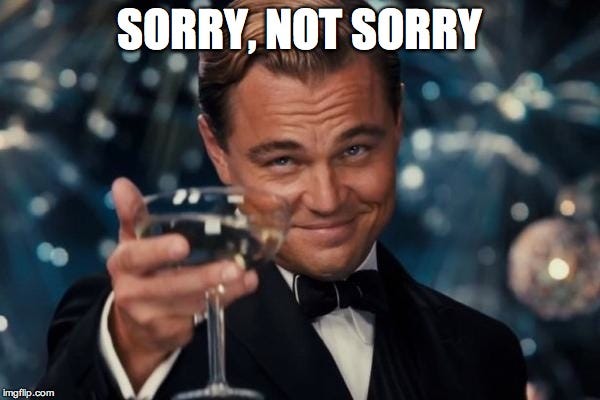
It lay within a Hollywood adage we’ve all heard and are now seeing in grand, sweeping effect: when the stakes are this high, it’s just better corporate business to say “I’m sorry.”

By the way, remember that if you like this blog, you can subscribe here! There’s a free signup so your Return on Investment is enormous.